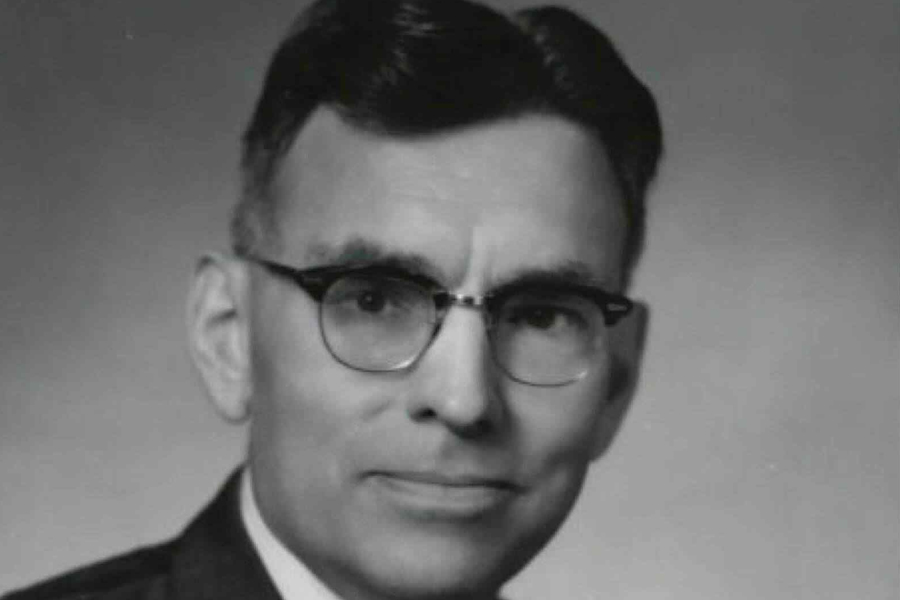
Early Life and Omaha Foundations
Howard Homan Buffett entered the world on August 13, 1903, in Omaha, Nebraska. His childhood unfolded within a grocer’s household, where thrift and steadiness carried real authority. Ernest Platt Buffett, his father, offered practical example rather than theatrical grandeur. Henrietta Duvall Buffett, his mother, shaped his early sensibilities with quiet fortitude.
Omaha gave Howard a civic and commercial education before formal credentials arrived. He attended public schools and later enrolled at the University of Nebraska Lincoln. In 1925, he graduated with a journalism focus, which sharpened his appetite for words and public argument. That same year, on December 26, he married Leila Stahl, creating a domestic partnership that would become historically consequential.
Entrepreneurship and Depression Era Discipline
Howard moved quickly into commerce after university. By 1926, he had founded Buffett Falk and Co., a brokerage firm. The enterprise demanded nerve, judgment, and a disciplined temperament. Those traits would become central to his public reputation.
The Great Depression tested every assumption about money and security. Howard responded with a preference for tangible reserves rather than airy promises. He accumulated gold coins, a crystal chandelier, sterling silver, and even a farm. These holdings reflected a world view anchored in durability, scarcity, and resistance to monetary turbulence.
Such choices were not merely eccentric safeguards. They represented a philosophy of personal sovereignty. Howard trusted physical assets because he distrusted inflationary abstraction. His habits became a living seminar in prudence for his family.
Political Ascendancy and Congressional Identity
Howard’s business experience eventually carried him into politics. From 1939 to 1942, he served on the Omaha Board of Education. That post allowed him to refine his instincts about limited government and local responsibility. It also gave him a platform for a larger political ascent.
In 1942, he won election to Congress as a Republican from Nebraska’s 2nd district. He served from 1943 to 1949, then again from 1951 to 1953. Those ten years placed him inside a volatile era of war, recovery, and expanding federal power. Howard aligned himself with the Old Right and resisted New Deal expansion.
His legislative posture was severe and deliberate. He opposed foreign aid schemes, executive concentration, and interventionist enthusiasm. He believed such policies diluted liberty and invited endless entanglement. To his allies, he was a principled sentinel. To critics, he was an obstinate dissenter.
Gold Standard Convictions and Public Arguments
Howard’s economic convictions reached their sharpest expression in 1948. He wrote “Human Freedom Rests on Gold Redeemable Money” for The Commercial and Financial Chronicle. The essay argued that inflation was corrosive and morally evasive. He treated stable money as a civic safeguard, not merely a technical instrument.
He viewed the gold standard as a defense against political improvisation. In his reasoning, redeemable currency restrained government excess and protected citizens from hidden erosion. He spoke with unusual urgency about inflation’s stealth. That language gave his economic thought a moral dimension.
Howard also resisted the Truman Doctrine and questioned American military commitments abroad. He urged declassification of CIA material concerning the Korean War. Such positions placed him outside mainstream consensus. Yet they also secured him a durable reputation among libertarians and anti intervention thinkers.
His affiliations reinforced that reputation. He was linked with the John Birch Society beginning in 1959. He also received a perfect conservatism score from Americans for Constitutional Action. These associations cemented his image as an uncompromising defender of constitutional restraint.
Marriage, Children, and Household Tensions
Howard’s home life contained both affection and friction. He and Leila had three children. Their family became one of the most discussed dynasties in American finance and philanthropy. Yet the household also carried emotional strain.
Doris Buffett, born in 1928 and deceased in 2020, became a notable philanthropist. She founded the Sunshine Lady Foundation in 1996. Her work supported domestic violence victims and practical education. She later described her approach in a 2010 book, and she credited Howard with teaching generosity and unconditional love.
Warren Buffett, born on August 30, 1930, became the family’s most famous figure. He has led Berkshire Hathaway since 1965. By 2023, his wealth was estimated above $100 billion. Howard introduced him to investing and reading at a young age, and those lessons matured into global influence.
Roberta Buffett Elliott, born in 1933, maintained a quieter public profile. She co founded the Sherwood Foundation with her siblings in 2000. Her philanthropy supports education and Omaha community initiatives. In different ways, each child translated Howard’s values into public action.
Leila’s emotional volatility complicated family relations. Doris often felt especially strained by that atmosphere. Howard did not erase those tensions. Still, his practical steadiness gave the children a model of endurance under domestic pressure.
Descendants and Expanding Philanthropy
Howard’s legacy widened through grandchildren and great grandchildren. Their pursuits ranged from agriculture to diplomacy, from arts to scholarship. Each generation inherited a variation of his seriousness. Some chose commerce, while others favored humanitarian service.
The family tree can be simplified as follows:
| Generation | Key Members | Birth Years | Notable Focus |
|---|---|---|---|
| Parents | Ernest Platt Buffett, Henrietta Duvall Buffett | 1877, 1873 | Grocers, early stability |
| Howard’s Generation | Howard Homan Buffett, Leila Stahl Buffett | 1903, 1904 | Investing, politics, family formation |
| Children | Doris, Warren, Roberta | 1928, 1930, 1933 | Philanthropy, investing, civic support |
| Grandchildren | Howard Graham Buffett, Susan Alice Buffett, Peter Buffett | 1954, 1953, 1958 | Global aid, education, music |
| Great grandchildren | Howard Warren Buffett, Nicole Buffett, Erica Buffett | 1983 and later | Scholarship, art, charitable activity |
Howard Graham Buffett founded the Howard G. Buffett Foundation in 1999. The foundation has focused on poverty reduction, conservation, and food insecurity. His efforts reflect a form of disciplined humanitarianism. That instinct harmonizes with Howard’s suspicion of wasteful grandiosity.
Susan Alice Buffett has supported arts and education through philanthropic work. Peter Buffett has cultivated music and authorship, including “Life Is What You Make It.” Their public lives display breadth rather than uniformity. Yet each remains connected to the family’s ethic of responsibility.
Howard Warren Buffett, born in 1983, has become known for academic and political work. Nicole Buffett and Erica Buffett have also pursued creative and charitable paths. Their lives show that the family’s influence extends beyond finance. The lineage has become a varied instrument of public purpose.
Enduring Public Memory
Howard Buffett continues to surface in debates about money and government. His gold standard views attract renewed attention during inflationary episodes. His anti war positions also reappear whenever foreign policy grows contentious. This cyclical remembrance gives him an unusual afterlife.
Warren Buffett’s prominence keeps Howard’s name visible as well. Discussions of succession, stewardship, and philanthropy often circle back to the elder Buffett’s formative lessons. Howard’s emphasis on reading, discipline, and caution remains part of the family mythology. It is a mythology grounded in concrete habits rather than ornament.
Modern admirers often view Howard as a precursor to later libertarian arguments. Others see him as a stubborn traditionalist from a more combative age. Both readings contain truth. He was a man of intense convictions, and those convictions resisted dilution.
Key Takeaways
Howard Homan Buffett blended business, politics, and family influence into one durable legacy. Born in 1903, he rose from Omaha’s modest commercial world to national political significance. His brokerage work, congressional service, and gold standard advocacy revealed a mind disciplined by skepticism. He distrusted inflation, foreign entanglements, and federal overreach.
His greatest long term impact emerged through his family. Warren Buffett absorbed lessons about reading, investing, and restraint. Doris, Roberta, and later descendants translated different elements of his ethic into philanthropy, scholarship, and creativity. The family became a multigenerational expression of stewardship.
Howard’s life also showed the friction between conviction and domestic complexity. He was not a sentimental public relic. He was a forceful man who valued principle above convenience. That severity, coupled with practical love, helped shape one of America’s most influential families.